

Latest Products


Contact Us
- 612, Building 9, Donghai Cross-border E-commerce Ecosphere, Fengze District, Quanzhou
- ivy.su@cnccib.com
- +8613505927626
Wholesale Cast Film Machine Manufacturer
CCIB was established on year 2001, it's producing plastic machine and plastic film as the core industry of manufacturing enterprises. Our products include: Cast Film Machine, Blown Film Machine, Packaging, Plastic Machine, TPU Film, PE Film, PEVA Film, Film Winding Machine, Recycling Machine, Printing Machine, Bag Making Machine.
Why Choose Us
High Production Capacity
CCIB is producing plastic machine and plastic film as the core industry of manufacturing enterprises. The total assets is 1.2 billion, with 500 workers. Our company gained the national patent over 20 items.
Quality Assurance
We focus on technological innovation, and introduce the production technology and processing equipment of world's advanced level. Our quality assurance technicians verify every lot of parts to ensure it meets our customers’ high standards.
Wide Product Range
The main products of Machine and Plastic film are as follows: film blowing machine, film winding machine, recycling machine, printing machine, bag making machine.
Leading Service
We independently complete the R&D, production, marketing, sales, and technical support processes. You just need to send your requirements via email and we can customize the product for you.
 EVA Hot Melt Adhesive Film Machine
EVA Hot Melt Adhesive Film Machine is suitable for producing various hot-melt adhesive pellets, hot-melt adhesive sticks, and hot-melt adhesive films.
Add to Inquiry Breathable Film Machine
With the same extrusion process as other cast film lines, the cast breathable film line is particularly equipped with the MDO (Machine Direction Orientator) unit.
Add to Inquiry Automatic Extrusion Laminating Machine
Our extrusion laminating machines can meet the different needs of customers for excellent speed, flexibility, reliability and durability. Continuous technological development through innovation is
Add to Inquiry Perforated Film Making Machine
The perforated film machine uses polyethylene to produce microporous film. In this process, the molten resin from the extrusion die is formed into a film, and the vacuum perforation process is
Add to Inquiry CPP Film Extrusion Machine
CPP Film Extrusion Machine production line, high speed and professional, active and multi-application. The most optimized production line configuration is suitable to many kinds of raw material: PE,
Add to Inquiry Super Transparent EVA Film Making Machine
The extrusion line of this machine is usually designed to produce environmentally friendly EVA and PU films. The use of advanced film surface treatment technology shows extraordinary effects on the
Add to Inquiry EVA Sheet Lamination Machine
This lamination machine used in gluing and laminating EVA, sock lining, fabric and other materials. Apply to adhesive environment friendly materials such as shoemaking, cloth making, bag, case, sport
Add to Inquiry PE Film Packing Machine
Automatic PE Film Packing Machine is suitable for wrapping pop-cans, bottles, etc, both with bottom-tray and without bottom-tray, working with PE shrink tunnels.
Add to Inquiry PE Film Extrusion Machine
PE Film Extrusion Machine is mainly for extrusion and blowing of HDPE, LDPE and LLDPE filmm. If replacing the mould and air ring, it can also produce EVA film.
Add to Inquiry CPP Film Extrusion Line
Our CPP Film Extrusion Line is good for producing high quality transparent metalizing grade CPP film, widely used for packaging application.Various width of machines are available from 1200mm to
Add to Inquiry Cast Film Production Line
The manufacturing technology of Cpp cast film production line includes the design of feeding, extruder, melt line (including filtration, metering), die, casting, traction and winding.
Add to Inquiry CPP Film Line
The CPP film production line is used to produce high-quality cast polypropylene film (CPP film) suitable for various packaging applications.
Add to Inquiry
This unit mainly applies Low-density polyethylene and adopts several kinds of resins to manufacture single/double-side self-adhesive three-layer stretch wrapping film by extrusion. The multi-layer co-extruded stretch film has better tensile strength, puncture resistance, and impact resistance than single-layer or two-layer stretch wrap film. Its good shrinking memory and self-adhesive function can ensure the integrity of goods, preventing them from loosening, collapsing during transportation, and being polluted by dust.
Benefits of Cast Film Machine
Consistent mechanical properties over time and full web width
01
Best in class md and td thickness tolerances
02
Outstanding reel geometries with constant film tension
03
Low unwind forces for quieter high wrapping speeds and on pallet cling
04
Consistent film performance during the wrapping process with less film breakages
05
●Higher production with consistent stretch film quality, superior by more than 30% to the same providers.
●Higher speed, good optimum tensil, and anti-pricking film ensure that the machine produces a large amount of output.
●To achieve uniform and good ductility film, good water cooling effect and imported die steel are used.
●To regulate the layer thickness and evenness, a swing system was fitted.
●The alloy screw has a unique mixing function and a high plasticizing design that combines an import static mixer to provide excellent plasticization, uniform colour, and increased extrusion capacity.
●Fully automated and controlled by a PLC.
●Imported top special mould steel is used in the Coat Hanger type T-die material. By using a very accurate technique and treatment, the T-die may be used for a long time with no distortion. In the meantime, ensures that material extrusion is smooth and steady.
●Inside the cool roller, a two-way circulation design and a spiral flow path guarantee that the roller surface temperature is consistent.
●The Winding Station may be moved forward and backwards. Uses a high-torque motor with automated tension adjustment on all four axes. Both the speed and the breadth of the film may be adjusted.


The casting machine is a special equipment for producing cast film. It mixes pulverized powder with binder, plasticizer, dispersant, and solvent to make a slurry with a certain viscosity, and the slurry flows down from the hopper. It is coated on the special base tape with a scraper with a certain thickness, and then dried, mixed with plasticizer, dispersant, and solvent. Then, the green tape needs to be punched and laminated according to the size and shape of the finished product. The machine equipment for making finished blanks needs to be sintered. The film blowing machine heats and melts the plastic particles, and then blows them into a film. There are many kinds of film blowing machine knives, such as PE, POF, and PVC, and so on.
Components of Cast Film Machine


Feeding System
Feeding systems regulate the amount of material fed into extruders by weight rather than volume. In many situations, the film is made from ingredients that are a combination of a base polymer and one or more secondary components.
Extruder
An extruder's primary functions are to melt plastic materials and mix the resulting molten polymer to obtain a homogeneous mixture. This is accomplished by moving the material with a spinning screw along a heated barrel.
Filtration System
The filtration system is used to prevent the downstream passage of melt impurities and gels generated during the process. Filters with metallic mesh are the most frequently used.
Flat Die System
Flat die system is the heart of a cast film coextrusion line. This system consists of the coextrusion feedblock, flat die, and melt transfer adapters that deliver various molten resins from the extruders to the feedblock input ports.
Cooling Unit
A primary roll, a secondary roll, a motorized roll, a vacuum box and an air knife are components of the cooling unit. The rolls are often chrome coated to improve surface polish and heat transfer during the film cooling process. Water that circulates inside the rolls is typically used as a cooling agent. The primary quenching roll cools one side of the film while the secondary roll cools the other.
Automatic Gauge Control System
The gauge control system, or APC, measures and controls film thickness. This system is made of a radiation emission device and a control console. The radiation unit moves over the machine, scanning the film in cycles. Meanwhile, the control system provides power to the thermal translators as needed, and the lip gap is controlled through the thermal expansion of the adjustment element.
Corona Treatment
A surface treatment is required to assist the adhesion of inks or coatings onto the film surface. Corona treatment is the most widely used procedure currently available. It increases the surface energy and thus the surface tension of the film.
Winder
Winders transform extruded film into rolls of material. The winding procedure must be consistent so that the film's qualities and dimensions are preserved when the rolls are unwound and transformed in other downstream operations.
Computerized Control System
The main components of a cast film extrusion line described above do not operate manually but are integrated and governed by a computerized supervisory and control system. The main functions of this system are controlling the line's start-up, shutdown, and speed, maintaining a steady throughput, monitoring the weight of material supplied into the extruders and managing the speed of the extruders, etc.
Process of Cast Film Machine

Resin preparation
Stretch film is made up of a unique blend of polymers, including various different additives such as pigments, UV resistance, and tackifiers. The LLDPE resin is mixed with these additives, such as colorants and stabilizers, to achieve the desired properties of the film. Once the correct polymers have been loaded, the film extrusion process begins.

Extrusion
Firstly, the resin mix heated and melted until it is molten and has reached the correct viscosity. The molten material is forced through a flat die to begin the cooling and shaping process.
Cast film is cooled by passing the flat sheet through a series of large rollers, which cool and solidify the material. This process is known as casting because the resin in cast onto the chilled roller which gibes the film a smooth, transparent surface.

Blown film
It is a very different extrusion process to cast. The molten material is cooled by inflating the resin into a very large bubble, several meters tall. This causes it to expand and become thinner as it cools. The size and thickness of the bubble is carefully monitored and controlled to ensure the film has the desired properties before it is fed into the machine to be stretched.

Winding
Sed ut perspiciatis unde omnis iste natus error sit voluptatem accusantium doloremque laudantium, totam rem aperiam, eaque ipsa quae ab illo inventore veritatis et quasi architecto beatae vitae.

Slitting
The large rolls of film are then slit into smaller rolls of various widths, depending on the desired product specification.
Cast Film Machine Troubleshooting Tips
Gels, Un-Melts, Charred Polymer: Overheated/Degraded Polymer, Poor Melting of Polymer, Foreign Impurities in Resin Stream
Reduce melt temperature or if un-melts, increase extruder barrel temperatures
Check thermocouple installation and accurate heater control
Worn or Damaged Extruder Screw – Inspect & measure screw dimensions
Worn or Damaged Extruder Barrel – Inspect & measure barrel ID
Check resins and material handling for foreign contamination
Poor or Non-Uniform Optical Clarity: Indicates Inadequate Extrudate Quenching
Extrudate melt temperature too low, raise melt temperature
Cast roll quenching temperature too high, reduce cooling water temperature
Needs improved film to cast roll contact, Increase vacuum box, increase air knife
Co-extrusion interfacial instabilities – adjust layer thicknesses via extruder outputs
Melt Fracture “Sharkskin”: Low Melt Temperature or Die Gap Too Narrow
Raise melt temperature via heater setpoints
Activate die lip heaters if equipped
Increase die gap
Voids, or Gray Streaks: Indicates Potential Moisture in Resin Stream
Identify the cause of moisture in the material handling system
Water condensation on extruder feed section can occur (hot, humid environment)
Ensure raw materials are dry
Milky Areas: Indicates Contamination by an Incompatible Polymer
Identify where the contamination is occurring and eliminate it
Clean/purge the resin material handling system, hopper and dryer
Purge the extruder with an un-blended neat base resin
Disassemble and clean the extruder barrel, feedscrew and die (if needed)
Discoloration: Indicates the Extrudate Melt Temperature is Too High
Lower the barrel temperature to recommended levels
Poor Pigment Dispersion: Indicates Poor Mixing or Uneven Melting
Residence time improper for accurate mixing, Increase back pressure/residence time
Melt temperature improper for accurate mixing, Lower temperature to increase shear
Inspect blending dosing unit for accurate & consistent color masterbatch feeding
Evaluate the feedscrew design; change or modify if needed
Evaluate the resin rheology compatibility
Gauge Bands, Die Lines, Film Lines: Indicates Contamination at Die Lips, Die Adjustment Issues, & Vacuum Box Adjustments
Die lip is dirty – Clean (shim) die lips at localized lines
Die manifold is dirty – Split, clean, and inspect die
Die lip out of adjustment – check die gap and re-gap
Inspect vacuum box for leaks and localized high air velocities, re-adjust
Inspect air knife for localized high or low air velocities, clean & adjust air knife gap
Plate-Out / Chill Roll Deposits: High Entrapped Air Between Chill Roll And Film, Poor Nip Contact With Plate-Out Roll
Inspect plate-roll surface condition, replace if poor
Inspect for even nip contact force across plate-out roll & cast roll
Increase plate-out roll contact nip pressure
Reducing plate-out -Increase vacuum, reduce melt temperature, increase cast roll temperature, reduce resin additives (slip, anti-blocking)
Film Blocking: Indicates The Winding Tension or Corona Treatment Level Is Too High
Reduce winding tension
Lower treatment levels
Inadequate film cooling/quenching, reduce cooling roll temps &/or reduce line-speed
Inadequate levels of anti-block additive, increase anti-block
Production Capacity
The first factor to consider is production capacity. The production capacity of a cast film line depends on the output rate, which is the amount of material that can be cast per unit of time. It is critical to choose a cast film line that will meet your company’s production needs.
To determine the required capacity, you need to consider factors such as market demand, product specifications and production schedules. Higher capacity comes with a higher price tag, so it’s important to balance production needs with costs.
You also need to evaluate the output of your cast film line against your production needs. The output rate of a cast film line can be affected by a variety of factors, such as material type, film thickness and product complexity.
Material Compatibility
The second factor to consider is material compatibility; CPP cast films can be made from a variety of materials, including polypropylene, metallocene polypropylene and other polyolefins.
Choosing the right material for your cast film process is critical. The material should be compatible with cast film line components, including extruders, dies and cast drums. Incompatibilities between materials and components can lead to poor product quality, equipment damage and reduced production efficiency.
You should also consider material properties such as melting point, viscosity and flow rate. These properties affect the quality of the cast film process and the final product.
Equipment Characteristics
The third factor to consider when selecting a CPP cast film line is the equipment characteristics. The characteristics and capabilities of a cast film line affect the efficiency, productivity and quality of the final product.
One of the basic characteristics to consider is speed. The speed of a cast film line determines the output rate and production capacity. Higher speed means higher productivity, but it also requires more energy and can lead to lower product quality.
Another key feature is accuracy. A cast film line should be able to maintain consistent film size and quality. Inconsistent film sizes can lead to product rejection and increased waste.
Ease of use is another essential feature to consider. The cast film line should be easy to operate, maintain and clean. Complex and challenging operating equipment can lead to reduced productivity, increased downtime and higher maintenance costs.
Maintenance and Support
Maintain optimal performance, efficiency and equipment life of your CPP cast film line. Regular maintenance helps prevent downtime, reduce maintenance costs and improve the quality of the final product.
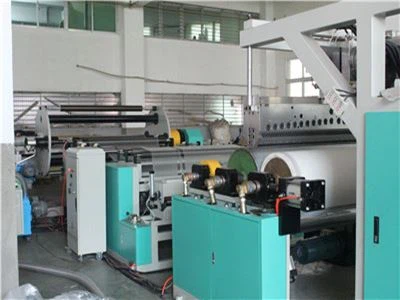
Our factory
We also invested three plastic film company in aboard as below:
●Vietnam: VINA KAILO CO., LTD
●Indonesia: PT. KAILO SUMBER KASIH CO., LTD
●Egypt: Egyptian Arabic for Paper Productions


Contact Us
Phone
+8613505927626
Address
612, Building 9, Donghai Cross-border E-commerce Ecosphere, Fengze District, Quanzhou
ivy.su@cnccib.com
Frequently Asked Questions
Q: Cast film Machine vs blown film Machine which one is better?
Direction and type of die: Blown film extrusion process extruded resins vertically with a circular die, creating a thick layer of film with bubbled shape. Cast films are made by melted thermoplastic horizontally through a flat die to create a fine sheet of film.
Cooling speed: The cooling process of blown film extrusion is much slower because the bubble-shaped film is gradually cooled. While the instant cooling technology of cast film extrusion enables faster production line speeds.
Clarity: Cast film tends to be clearer and shinier, whereas blow film gives less clarity due to crystallization that occurs during manufacturing.
Resistance to stretch: Blown stretch film is very resistant to puncture while cast films are not as good as the former.
Unwind noise: Cast film extrusion makes less noise unwinding than the other.
Usage: Factories usually preferred blown film for wrapping sharp-edged products and heavy loads, and cast film for lighter products.
Q: What is the Cast Film Machine production process?
Melting the thermoplastic materials, Flattening and solidifying, and Trimming and rolling.
In the cast film extrusion process, the molten materials are extruded through a slot die onto an internally cooled chill roll. Then, it goes through a set of rollers that determine the qualities of the cast film such as thickness. After this step, the cast film is trimmed and rolled.
Melting the thermoplastic materials
The process starts with the feeding of plastic resins using a gravimetric feeding system to one or more extruders. The materials are subsequently melted and mixed into a consistent mixture by the extruders. The most commonly used materials for cast film extrusion are polyethylene (PE) and polypropylene (PP).
Flattening and solidifying
Once molten by the extruders, the materials travel to a flat die to be flattened into a thin film. This film is drawn to the surface of a cold roller, where it is cooled and solidified by using an air knife or vacuum box.
The main two rolls subsequently cool both sides of the product. This step helps the fine film rapidly quench, which improves its mechanical features and clarity. The thickness of the film might range from less than 10 microns to 200 microns. The cast film can be monolayer or multilayer, with a maximum of 5 layers.
Trimming and rolling
In the final stage, the film is then passed through a sequence of cold, polishing, and nip rolls to help form the desired thickness. It is then trimmed and wound into a drum for storage by a winder.
Q: What is Cast Film Extrusion Machine ?
Q: What are features of Cast Film Extrusion Machine ?
Film thickness 0.03~1 mm.
Equipped with a fully automatic winder with cutting and changing rolls functions.
Hydraulic screen changer for short maintenance stop.
Q: How Cast Film Machine works?
Q: What is the difference between blown film and cast film processes?
Q: How often does the Cast Film Machine need to be cleaned?
To make a complete cleanout of polymer possible, most dies have to be hot. Working with a hot, heavy die can raise safety issues as well as expose the die to possible damage resulting from mechanical impacts. To minimize these concerns, it is important to carefully follow the recommended steps for carrying out a split and clean.
Q: What is the cleaning process for Cast Film Machine?
It is strongly recommended that the die body bolts be loosened while the die is still online, leaving four body bolts hand-tight, one on each end and two toward the center. This will prevent the die from cooling during offline disassembly. Once the die bolts are loose, you can unplug the electrical components.
When working around the die, pay close attention to avoid impacting it, especially the front edges, the pilot, or the ends. Always use the protective cover when transporting the die or when torquing the die body bolts. No power tools should be used. No matter how carefully you handle them, damage will occur to the flow and seal surfaces.
Disassembling the Die Offline
Once the die is placed onto the working surface, remove the end plate and seal plate assemblies. Use the Allen wrenches to remove the die body bolts—remember that these will be hot. Underneath each bolt (except on some older dies) is a washer that must also be removed. Places the bolts and washers on a heat-proof surface and clean each one.
Before separating the die bodies, attach the lifting device to the eye bolts and make sure that the lifting chain is drawn tight in a perfectly vertical position so that the upper die body will be lifted straight up. Next, apply a generous coating of anti-seize to the jack bolts and insert them into the jack bolt holes (designated by the letters JB) on the die body. Hand-tighten all of them, turning each approximately the same distance.
At this point, remove the protective cover from the front of the die and insert brass, aluminum, or high-temperature plastic shim stock—slightly smaller than the lip opening—between the lips. This will protect the lip surfaces in case the surfaces bang against each other as the die is taken apart.
Continue tightening the jack bolts. Some will loosen as others are being tightened, and the lip gap will start to open up. Check on the back of the die to make sure that the splitting of the die is even. If the opening on one side is narrower than the other, you need to apply more pressure to the jack bolts on that side. As the die bodies separate, the lifting chains become loose and have to be periodically readjusted as you apply more tension to the jack bolts. Keep turning the bolts evenly, keeping an eye on the gap between the die bodies to make sure that the bodies are parallel. Do this several times until the upper die body clears the dowel or guide pins that align the die bodies. At this point, you can use the lifting device to raise the upper die body.
Cleaning the Die
As the die body is raised, you can cut the molten polymer strands that stretch between the die bodies. Then move the upper die body away from the other half, remove the jack bolts so that they do not seize up, lay the upper body down on a clean protected surface, and turn it over.
Once the bodies are separated, they will start to cool quickly, so you will need to remove the polymer as quickly as possible. Having a coworker (or coworkers if it is a large die) clean one of the die halves while you clean the other is a good idea. Using an assortment of brass scrapers, remove all of the polymer from the flow surface, the front lip edge, and the seal surface. Scrape the die lengthwise where possible.
Next apply the die soap to all of the above surfaces, working on one section (about two feet) at a time. The soap will melt as it is applied. Using steady pressure, rapidly clean away the die soap with the copper gauze, being careful not to let the hot soap splatter onto you or a colleague and also avoiding getting the soap into the threaded body bolt holes, where it would be very difficult to clean out. You will need to change to fresh gauze periodically. Now is the time to inspect the flow surfaces and front edges of the die to see if there are nicks, dents, or dings that need repair. It may be possible to minimize the damage while the die is on-site at your plant, but in general, it is not possible to do a full repair. Consult your die supplier. Many variables affect the severity of the damage and the type of repair that is required. You may need to send your die to the supplier for rework, although the supplier’s service team may be able to polish out dings at your facility—or, for a short-term fix, fill in a ding with nickel.
Reassembling the Die
Before placing the upper body over the lower one, apply a thin coat of anti-seize to the dowel pins and place the shim stock on the die lip surface of the lower body.
You will need to work with a colleague as you lower the upper body onto the lower one. One of you will hold the upper body straight, using a straight metal bar, as it is being lowered into position, while the other person closely monitors the positioning of the upper body onto the dowel pins and uses a steel handle to keep the die halves completely parallel. Once the upper body has been lowered onto the pins and the lift chains have become loose, it often happens that there is still a gap between the bodies. To remedy this, take two body bolts, coat them with anti-seize (on the head and threads, as well as on both sides of the washers), insert them into the center of the die, and, using the Allen wrenches, hand-tighten them. When doing this, make sure the die halves are parallel as they are being squeezed together. You may need more than two bolts for longer dies. Once the die bodies are together, start from the center to insert the remaining body bolts (each should be similarly prepared with anti-seize).
Torquing of the body bolts should be done after the die has been put back online. Before torquing, place the protective cover over the lip area. Refer to your Operation & Maintenance Manual for the body bolt torquing sequence and specifications. Using smooth movement of the torque wrench, begin with the four center bolts, using a crisscross pattern between the four. Then, move on to the next outer bolt on each side, and so on until all bolts are tightened.
Finally, install the end plates onto the die with cleaned and anti-seized bolts, followed by the end seals and the end seal push plates. Note, the end seals should be replaced with new ones every time the die is taken apart. The end plate bolts should not be torqued until the die has been brought up to operating temperature and the lip gap has been set. At that point, your die is ready to go back into production.
Q: What is the process of cast film machine?
Q: How should we perform daily maintenance on Cast Film Machine?
Q: How to choose the right Cast Film Machine?
We're professional cast film machine manufacturers in China for over 20 years, specialized in providing high quality products. We warmly welcome you to buy cheap cast film machine from our factory. For price consultation, contact us.
roq printing machine, cast machine stretch film, plastic pouch packing machine